
Mid-season verdict: "Spartacus: House of Ashur" is a love story of freedom, ambition, and power.
Reel Perspectives
December 29, 2025

"Achillia! Achillia!! Achillia!!!
Spartacus: House of Ashur is a masterclass in entertainment. The Spartacus spinoff created by Steven S. DeKnight premiered exclusively on Starz on December 5, 2025, and has been a rollercoaster of high-octane drama, suspense, violence, and gore... did we mention gore? But at its heart, it's a love story - a love story of freedom, ambition, and power.
At the halfway mark, Spartacus: House of Ashur proves itself far more than a nostalgic spinoff. It's a confident, blood-pumping return to the brutal political theatre that made the original series iconic. By centering the story on one of Spartacus' most cunning and divisive figures, Starz has crafted a mid-season run that feels both daring and deeply familiar.
The series follows Ashur (Nick E. Tarabay), a former slave and gladiator in an alternate timeline where he is not killed in Spartacus. Instead, he is gifted Batiatus' ludus and becomes master of his own gladiator school as a reward for killing Spartacus and aiding the Romans. Any former slave with newfound status would be content to live in the status quo, but Ashur is striving for greatness.
Ashur is shrewd, bold, and every bit as treacherous as we remember him from Spartacus, however, Tarabay plays him with such vigor and sincerity that it's difficult to hate him, even when everything he does is for his own self-interests at the expense of everyone else.

The show's greatest strength is its commitment to character. Ashur, once defined purely by treachery, is now explored with surprising depth. His ascent is not a redemption arc so much as a study in ambition and survival, and Nick E. Tarabay relishes the opportunity to make Ashur both repulsive and compelling. You don't have to like him—but you absolutely want to watch him. Every alliance feels temporary, every victory earned at a cost, which keeps the tension razor-sharp.
Ashur, continually disrespected by the Roman elite, who take every opportunity to spit on his very existence as "the Syrian", becomes increasingly obsessed with greatness, leading him to a chance, almost kismet, encounter with Neferet (Tenika Davis), whom he renames Achillia, in hopes she becomes the arena's first-ever female and Nubian gladiatrix, to aid his ambitions.
Seeing her potential, he immediately plucks Neferet from a life of enslavement and obscurity and gives her the opportunity to achieve greatness as his lead gladiator, positioning them both for a life of opportunistic gain. Achillia's very presence is both an invasion and affront to the senses for the Roman elite and for her very own brotherhood. She's relentlessly mocked, ridiculed, and humiliated by the pervasive misogyny and racism to prove her worth. In episode 5 titled "Goddess of Death," she defeats a surprisingly larger opponent, earning her place not just as a noble competitor but as the very thing Ashur envisioned for her, earning the title Goddess of Death. Davis' portrayal is compelling and filled with so much emotional depth that she makes you want to break out in a warrior cry and head to the nearest arena.
Both Ashur and Neferet have something to prove. While Ashur's ambition drives him to resort to lies and treachery to get what he wants, Achillia is driven by her demons and by her acceptance of a Nubian woman's place in a man's world. Achillia, aided by Davis' fantastic performance, brings grit, complexity, and a fresh sense of purpose, and by mid-season, she's not just surviving, she's earning respect and reshaping expectations. Her journey is one of the many highlights of the series, poised to remain one of its most exciting elements as the series unfolds.
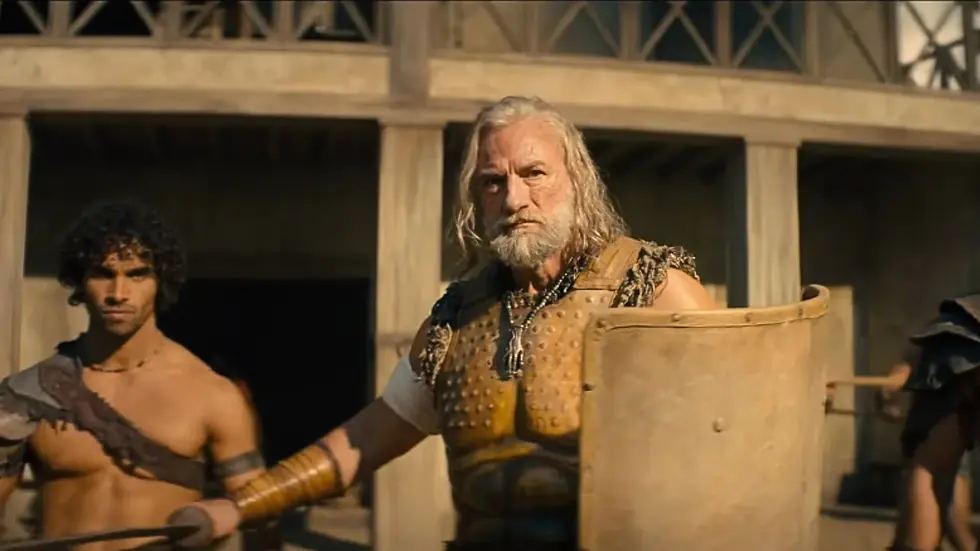
The supporting cast also shines, particularly Graham McTavish, who returns as the new Doctore. New characters are introduced with clear motivations and room to grow. Rivalries feel earned, loyalties are murky, and even quieter scenes crackle with menace. The series takes its time laying groundwork, and by mid-season, that patience pays off as multiple storylines collide in satisfying, often ruthless ways.
Visually and tonally, House of Ashur understands the Spartacus legacy. The stylized violence, operatic dialogue, and operatic stakes are all intact. The gladiatorial action is impactful without overwhelming the plot, while the political maneuvering inside the house is often just as gripping as anything in the arena. Power shifts constantly, and the mid-season episodes are especially effective at showing how fragile Ashur's position truly is.
Perhaps most impressive is how House of Ashur balances nostalgia with confidence, especially with its unique syntax. It respects what longtime fans love - boldness, brutality, and ruthlessness - while refusing to coast on brand recognition alone. The result is a series that feels revitalized, not recycled.
Mid-season verdict: Spartacus: House of Ashur is a triumphant return to form. It delivers the blood, intense action, betrayal, and sexual deviances fans expect, while offering a brilliant, character-driven narrative that stands on its own.
The first 5 episodes of "Spartacus: House of Ashur"are available on Starz. New episodes are released every Friday on Starz, the Starz app, and on-demand platforms.



Comments